Thursday, 21 June 2012

Susan Peters … Foundation lift for asthmatic patients


BY OLUSHOLA RICKETTS

HER voice floated quietly, but confidently. She was emotional as she spoke; and even with wide grin that spotlighted her elegant face, you’ll notice little tears dripping from her eyes.
  As a growing child, the Nollywood actress and model battled with asthma. The experience was not palatable. Now, she is determined to create more awareness about the ailment, which has killed many young people. “My experience, coupled with that of my father, a diabetic patient, made me think of setting up a foundation to cater for the less-privileged,” she says.
  
SUSAN Peters, the Benue State-born diva says she will officially launch her non-governmental organisation (NGO), 'Susan Peters Foundation: Benue Pikin' on May 30, her birthday. “I hope to use the organisation to enlighten more people, as well as, create awareness on childhood asthma and diabetes,” Susan says.
  “Childhood asthma is something most people don’t know about. So, I intend to create awareness about these two killer diseases — asthma and diabetes,” she pauses, as if to muster enough strength to say what is coming next.
  “I love charity and I hope to use the medium provided by the Foundation to contribute my quota to societal growth,” Susan says, in a voice that carries not only her dream, but also the spirit behind it.
  Reflecting back Susan says, before now, she’d always celebrated her birthday with inmates in orphanages,; using such occasion as an avenue to enlighten them on how to handle such cases.
  Since it is an NGO, the Foundation will source for fund both within and outside the country. Says Susan, “we are, however, looking up to kind-hearted Nigerians, corporate organisations and government for support to make the mission work.”
  
SUSAN’s break into Nollywood started with an excursion to Lagos in 2002 after a course in TV and Film in Kaduna. The actress, however, had her first shot at limelight, when she did a modelling job around 2004.
  Since then, she has graced so many billboards including those of BAT (British America Tobacco), Fidelity Bank, Keystone Bank, Golden Penny Pasta, U.H.F Long life Milk, Haemeron blood tonic, Airport Branding and others.
  However, modeling has not stopped her involvement in acting. In only a few years on the turf, she has featured in over 50 movies including Sound of poverty, Wicked Intensions, Stone face, Spiritual War, God Mother, Nollywood Hustlers, Bursting out, 30 days, Mortal attraction, Moment of Truth, Young Masters, Getto Language, The Begotten, Wasted Effort, My Diary, Squad 23, War Front 2, State of Emergency 2, Stolen Bible, The Hammer, Save the Crown, God Mother, The boy is mine and others.
  Is she comfortable with the way movies are flooding the Nigerian market?
  “Our videos now go through the cinemas before they are finally released into the market. You have to go see them at cinemas or have to wait for it to be on DVD,” she discloses.
  Susan believes there is no industry without challenges, even in politics. In the UK, she says they have their own lapses and “we have our own as well but we pray to God every day that it gets better."
She continues, “Nigeria is a big country, and there is no way you can compare the way video films are shot here with that of UK.”
  Then again, she pauses. “The way we work here is tense. We do back to back movies like there is no tomorrow. An executive producer won't just sit down and expect you to use a month to shoot a video that could take him some days. People in the UK don’t work like us; they work with ease.”
  How does she choose whom she works with and the work to be done?
  She says, commitment to the job and project determine that.
  As to the seeming stiff competition among actresses -- which often lead to conflicts or what is popularly called beefing; she tacitly admits such exists, but points out that men don’t really go through the same challenges and difficulties.
 “If a particular role is meant for this man, it is for the man. But in our case, we have lots of new faces that are equally doing well. Gone are the days that they use to beg a lady or woman to act,” she explains.
  But does this make her happy? “Maybe not,” she says. “The lesser the politics in Nollywood, the better.”
  She also puts a caveat: “There is need for more investment in the movie industry. If there are more investors, there will be more jobs for the youths. The industry is very large to accommodate everybody.”
  To what extent has her appearance fees influenced her life on the acting turf?
   While advising up-coming actresses and models to seek God’s love and favour, says, “if you have to be Susan Peters, you must have to forget about the money at present. When you are fresh in the industry or just coming in, the take-home is small. If you really have passion for the job, you must not think too much of money for now and make sure that you are relevant and get roles based on merit. The money will always come later.”

WHEN Susan got a call from Emem Isong to play a supporting role in her movie, Bursting Out, little did she know that the work would earn her, her first recognition outside the shores of the country.
  Few months after the premiere, the movie earned her the Best Actress Award for (Supporting Role) at the Nollywood and African Film Critics' Awards (NAFCA) held in North Carolina, USA.
   Though the category had other strong contenders such as Ini Edo, Nadia Buari and Roseline Ngissah; Susan’s troublesome character as Ibiere in the movie sure won the hearts of the judges and viewers, who voted massively for her in the competition.
   The NFACA recognizes work of professionals in the African film industry, including directors, actors, writers and humanitarian workers.  
  Apart from two international awards — Afro Hollywood Award, United Kingdom and Best Supporting Actress in America (NFACA), she has won two awards from City People magazine: Outstanding Performance in the movie industry (2012) and The Most Stylish Actress of the Year (2010) and Best of Nollywood (BON) last year. “I cherish all my awards because they are very importance to me," she relishes.
  Till date, she remains the only and first Nigerian Actress to feature in the International Afro American Magazine, Black Beauty And Hair.

Trivia
  Is she lonely at the top? “No,” Susan says. She is in fact surprised at the negative perception the society attach to single ladies.
  “Marital issue is so serious in our society. Any little thing, people will insult you to go marry as if marriage is the end of the world,” she laments.
 She adds that force has nothing to do with getting the right person. “Marriage will come at the right time. The reason many people experience-failed marriages is because of pressure either from family or their peers.”
  Susan advises women not to rush into marriage. “Take your time and get to know the person even though it takes forever to know someone.”
  If she finally marries, breaking up in the future won’t be an option. “I want a marriage that describes everything to do with 'for better for worst'.”

HER fashion sense?
  The award-winning actress says, “ I am a fashionista and good dress sense influences me.”
  The lady, whose most expensive fashion pieces are her Swarovski and diamond sets, says, she does not really have favourite designers. “I go for what fits me. My style is classy, edgy, trendy, sexy and sassy.”
  Susan says her beauty routine is simple ­— regular facial wash, use of moisturisers and a lot of water. She eats well, too. She uses any kind of shower gel and ‘clean and clear’ products for her face.


Ohiwerei’s Winning by His Grace


BY GREGORY AUSTIN NWAKUNOR

YOU’VE probably heard of (or maybe even bought into) the common misconception that obtaining a liberal arts degree will limit your ability to make it to the top in a boardroom. In fact, egocentric idealists are sure to tell you stories on how art underdeveloped the world, not how Europe underdeveloped Africa. Professor Emmanuel Ndubuisi Emenyonu’s biography of Felix Omoikhoje Aizobeoje Ohiwerei lampoons such idea.
   In his 298-page book, Winning by His Grace, Emenyonu articulates skills picked up at school, knowledge of the environment and recognition of what others are doing as essential for success in contemporary capitalism, definitely not choice of study. He celebrates the boardroom guru, entrepreneur and pastor for his successes in companies that he has worked and managed. Yet, Ohiwerei read Geography at the University of Ibadan.
   Emenyonu, president of United States and Africa Development Organisation, a Connecticut-based organisation, whose main objective is to promote business between the US and sub-Saharan Africa, is a professor of forensic, information and international accounting at the Southern Connecticut State University in the US.  
    The Imo State-born professor’s previous attempt to document the life and times of the late educationist, Dr. Akanu Ibiam, was not successful.
   He got close to Ohiwerei in 2005; and in the course of interacting with the boardroom veteran, he found in him qualities that were encouraging in terms of humility, keeping appointments, returning phone calls even to very minute level.
   In 2008, Emenyonu reached the conclusion that it would be good to write a book on him so that young people within and outside the country would know that there are not only men of integrity in Nigeria, but it is quite possible to be a business leader at the very highest level and do it with honesty and humility.
  "That was, quite frankly, my number one motivation for doing the book on him (Ohiwerei)," he says. "My encounter with him agreed with the general notion you perceive when you speak to people about him."
 
WITH a foreward written by Dr Christopher Kolade, the very exciting work underscores the value of hardwork and provides a new template for assessing success.
   The book is a ‘practical manual’ on management, and it covers everything you’ll need to know to be a good manager of men.
   Using Ohiwerei as the eye of the camera, the author tells you exactly the kind of mentality you’ll need to succeed, and the price you need to pay in order to make a success of your career.
   Taking a cursory look at the country, the author points out that of the major CEOs who have emerged in the last three decades in Nigeria, very few have been as thorough and mystifying as Felix Omoikhoje Aizobeoje (FOA).
   To list only a few of Ohiwerei’s qualities: he’s blessed with good height, affable and good humoured. These traits have endeared him to many. But they have not made him the winner he is. Rather, the book takes its deeper resonance from humility.
   Prof. Ayodele Falase, a renowned cardiologist and former vice chancellor of the University of Ibadan, says, “I can say it anywhere, if we want Nigeria to be fixed, that is the sort of man who can fix Nigeria and that is the sort of man people like us will work with.”
   Dr Paschal Dozie, founder and former chairman of Diamond Bank, says, “Felix Ohiwerei is a rarity. People like him are very rare in this country as of today. His character is impeccable. He is a man of rare qualities. He is a man of integrity.”
   Emenyonu, drawing inference from these positive expressions, writes that Ohiwerei has performed in a manner that is consistent with ideas that he holds dearly and virtues he defends whole-heartedly.
   In his classic, See You At The Top, Zig Ziglar writes: “When you sow an action, you reap a habit; when you sow a habit, you reap a character; and when you sow a character, you reap a destiny.”
  Ohiwerei, who is admired for his humility, tireless fight against corruption, makes CEOs understand the need to sow a character. The boardroom guru believes that the starting point for success and happiness, as Ziglar reveals, is ‘a healthy self-image’ — To be above board in their daily pursuit.
 
DIVIDED into five parts: Formative Years, Career and Starting Family, Retirement Years, Homefront, Faith, Principles, Accolades and Conclusions, each part opens the eyes of the reader to every detail about FOA. In many ways, it is a coming of age tale.
   Each part of Emenyonu’s biography engages students with the compelling story of the man who went from being the son of a village catechist to one of the biggest players in today’s boardroom. An Anglican by birth, married a Catholic, he has become one of the vanguards of Pentecostalism in the country. And each chapter has an emotional detail and testament.
   FOA, like the famed King Midas, has turned every outfit that he has managed or led in the boardroom into gold, inspiring tremendous growth in every one of them.
   In a straight forward manner, the author exposes what is often missing in many a-biography — detailed account of the subject’s life, especially major events that shaped them.
   In the five-part, 20 chapter-book, the author starts with a Why question! Why a biography on Felix Ohiwerei?
   A quote of William Makepeace Thackeray prefaces the answer: "Nature has written a letter of credit upon some men's faces that is honoured whenever presented. You cannot help trusting such men. Their very presence gives confidence."
   Incorporating serious scholarship, the book examines Ohiwerei in the larger context of the integrity movement. He tries to avoid a chapter being cursory, hopping or skipping details about the subject.
  Also, in answering the why question, the author says FOA evokes deep-seated respect and adulation from Nigerians across the divide.
   The book deconstructs Ohiwerei’s earliest dreams and ambitions in relationships with his parents, his siblings and classmates — primary, secondary and higher institution. The author speaks with everyone necessary to authenticate the Ohiwerei legend, including his elder brother and his wife, his uncle, his mentors — Pastor E A Adeboye, Dr Christopher Abebe, Chief Akintola Williams and Dr. Michael Omolayole — his lecturer at the university, Professor Akin Mabogunje, and a couple of classmates in secondary school.
 
IN the first part of the book, themed, Formative Years, the author introduces the character, his birth place and background, primary and secondary education and post secondary experience.  He also lists Ohiwerei's litany of achievements as board chairman and chief executive officer in Nigeria Breweries Plc, Unilever, Bankers Warehouse, Asset and Resource Management (ARM), New Nigerian Bank, Fidson Healthcare Plc., and others.
   Vey remarkable is the turnover of Nigeria Breweries Plc. The year before FOA was appointed the Managing Director and Vice Chairman, turnover was N207,476 million, by the time he stepped down as chairman, the turnover had soared to N111,748 billion, an increase of 54,284. 9 per cent. The profit after tax grew from N27,567,000 to N18,943,000,000. These owe much to his integrity, unblemished reputation, skills, humility, credibility and competence.
   In the 298-page book, the author captures him as a naturally ‘bright’ character without guile. Emotionally connected to what he is involved in, whether at small or large scale, Emenyonu looks at how he has transformed and concludes with the statement of the doyen of accountancy in Nigeria, Akintola Williams: “A man in whom there is no guile— honest to a fault and with whom no breath of scandal has ever been associated, FOA is a gentleman of outstanding quality and highest integrity, an administrator of irreproachable character.”
  In the opinion of Mr. Thom de Man, the president of Heineken, Africa and Middle East, “Felix Ohiwerei’s career will most likely be used as business case role model at Nigerian universities and beyond.”
   He continues, “In Felix, we see a man who rose to the highest level by rising through the ranks, knowing the facts and all times maintaining the highest level of integrity.”
   The most startling thing that the author discovers about Ohiwerei is that he is largely understated. He writes, "I have observed the way he spoke to bar maids; the way he interacted with them, very respectful. The most startling thing I realised is that whatever you hear about him is understated. The other thing is that there was nothing he told me, which on further investigation, turned out false."
   The motivational speaker, Ziglar, notes, “once you accept yourself, it will no longer be a matter of life or death for others to accept you. At that point, you will not be accepted, but you will be welcomed wherever you go.”
   Reflecting on the subject matter in part two, which looks at his career and starting of family life, the book ‘travels’ with Ohiwerei to some of his ‘ports of call’ or ‘tour of duty’ — Benin, Ore, Ondo, Akure, Lagos, Accra, London and many other cities across the globe. His encounter with his former bosses, Mr. George Pudney and Mr. Paddy Kelso, best exemplify the time honoured truth that no one on the face of this earth can make you feel inferior without your permission.
   After he was rebuked for poor merchandising, Ohiwerei settled down to work at the end, he and Pudney shook hands and ‘no complaint’ statement was registered for him in his performance appraisal sheet. 
  But more than the work, the author follows Ohiwerei to where he found Janet, his wife.
 
THE third part, which looks at the retirement years, reveals the disciplined qualities of the man. How he overcomes the challenge of post-retirement years without having to ‘soil’ his hands.
   The biography possesses inner warmth, with very apparent motive of coaching the reader to a life of success. And this suggests why the fourth and fifth chapters have been devoted to such purpose.
   Written in lucid, academic language that is devoid of any form of flowery or praise, the book makes ideal supplements for building a good brand in business environment where ethics and values are essential for success.
  As a ‘motivational’ book, it is a balanced profile that considers both Ohiwerei’s accomplishments and failures, very infinitesimal, as an individual and a corporate player.
  More than the story of Ohiwerei, it is the story of a self-made man triumphing over adversity, tragedies of great magnitude. It is an honest account detailing the life of ‘Mr. Transparency’ in the boardroom.
  It is a mix of motivation and biography rolled into one. Suffice it to say, the book is a call for more ethical way of doing business. It inspires you to follow the honest, disciplined and hardworking path for a satisfying life.


‘Dangerous lifestyles contribute to poverty of health in Nigeria’


 BY ANOTE AJELUOROU
Dr. Abimbola Silva is a Family Medicine Fellow. The best graduating student at the West African College of Physicians in her set, Abimbola is currently campaigning for a healthy lifestyle among Nigerians, as a way of raising the low life expectancy in the country to an appreciable level. She speaks more on the project.
 
You are a Family Medicine Fellow, what does that mean?
  Being a Fellow of the West African College of Physicians (WACP) in Family Medicine means that I am trained to be able to cater for the health needs of all family members irrespective of their age, sex or nature of illness. It means I am qualified to treat a baby, teenagers, mummies, daddies, grandpas and grandmas. Included in that training is the ability to recognise my limitations (no one doctor knows everything) and refer promptly and appropriately to other specialists when required. This is what particularly differentiates me from a ‘General Practitioner’ (GP) who may want to do all, for everyone, to please all. Of course, some GPs are also learning to know their limits in these days of litigation.
  My specific roles to the family include information and education to promote their good health and prevent illness as much as possible, prompt and effective management of acute illnesses including emergency, life-saving operations, management of long term illnesses to prevent or reduce complications as well as continued support and palliative care in cases of terminal illnesses.   

How healthy would you say the Nigerian family is?
  To answer that, I’d like to use the term ‘life expectancy’. It is an estimate of the average number of years a human being is expected to live in a particular society. It has been said to be associated with available opportunities in the society, the public health as well as diet. It varies in every society and it changes as these indicators change. In Japan, in 2011, life expectancy was estimated to be 82.6 years while in a country like Nigeria it was said to be 51 years in 2010 but now 47.8 years in 2011.
  It is no secret that the Nigerian society is more ‘Westernized’ today than 20 or 30 years ago. This is more so in the urban areas than in the rural areas. So while people would normally have eaten pounded yam and vegetable soup for breakfast, lunch and dinner, today, eating friend rice and fried chicken is more fashionable. People who would have walked 10 kilometres to the farm in the morning, would now be driven in cars, take a bus or okada to work or school. Instead of taking a stroll in the evening to fetch water in the stream, now we would pump water from our well while watching our favorite programme on a television that we would not even get up to tune, thanks to the remote control!
  Today, it is generally fashionable for our children to snack on biscuits and chocolates rather than oranges, pawpaws, bananas and tangerines. So, our healthy, fibre-rich vegetable and fruit-rich diets are being replaced by oil-laden, low fibre meals with little or no fruits. Also, our exercise or physical activity levels are reduced to the barest minimum.
  In the absence of strict laws against tobacco and alcohol use in Nigeria, advertising companies have tried very hard (and are still trying) to make cigarette smoking and alcohol use as attractive as can be to our youth.  
  They desperately need to get the children and youth ‘hooked’ on these harmful substances so that even in the face of reasonable evidence to declare the harm that the use of tobacco and excessive alcohol cause, these youth may find it difficult to say ‘no’. All these contribute to the poverty of health in the Nigerian family today.
  If I were to say what is lacking and the remedy, it would be that we must return to those fibre rich, low salt, low oil, vegetable and fruit-rich diets. This was the diet and lifestyle that kept some of our old people alive till up to 100 years in those days. This is also the type of diet that keeps the life expectancy so high in a civilised society like Japan.   
  They have somehow remained traditional in their lifestyle irrespective of the so-called civilization and development. They are known to walk, exercise and cycle a lot of times.
  We (Nigeria) must take a cue from them and learn to ignore as a matter of choice some of these machines that are supposed to make life ‘easier’ for us.
  Many of them make us more laid back and the lack of exercise promotes ill health. In addition, our laws on use of tobacco and alcohol as well as how they are advertised, must be much tougher so that people are well informed about what they are exposing themselves to.

You are campaigning about healthy lifestyles. What exactly does that mean?
  A person’s lifestyle determines his state of health. If culture is the way of life of a people as we were taught to define it in primary school, then we can definitely say a person’s culture determines their state of health.
  A healthy lifestyle is one that in totality would enhance good health. It would include eating a healthy diet, which contains the following: Carbohydrates, especially a lot of fibre, which aids digestion of food so that food passes along the food canal freely. 
  Proteins should be mainly plant-based as in beans and its products. For animal based protein, we should choose more of white meat such as chicken and turkey (without the skin) as well as fish over and above red meat (such as beef, pork or goat meat).
  Scaly fish are generally better as they have less oil but fish oil also contains Omega H-3, which contains the ‘good cholesterol’ that helps to remove ‘bad cholesterol’ from the body. Fats and oils should be those with low cholesterol such as sunflower oil, soybean oil or olive oil.
  These contain more of the good cholesterol that is needed to remove bad cholesterol from the body. The bad cholesterol is tagged ‘bad’ because it helps to form clogs inside the small tubes that carry blood around the body.
  As we all know, the heart is the organ that pumps blood around the body. Most of the tubes that carry clean blood all carry clean nourishing blood away from the heart to nourish the body. Only very few tiny tubes carry clean nourishing blood to nourish the heart itself. A major problem occurs when the tiny tubes that supply blood to nourish the heart become clogged up because of this bad cholesterol. Portions of the heart may become technically ‘dead’ and the person then may have a heart attack.
  Fruits and vegetables consumption should be encouraged among our growing children and adults alike. If eaten fresh, vegetables provide vitamins that help the body to fight illnesses. Eating at least one type of fruit a day is a good way to start.
  It is good to note that the nourishment in vegetables are only available to us if the vegetable is eaten fresh or raw in the case of some that can be eaten raw like cucumbers, carrots, lettuce.
  If vegetables have to be cooked, we should try to cook it in a way that any water that comes out of it remains inside the meal. This is because many vitamins inside the vegetable are water-soluble.
 This means that if you boil your vegetable and throw away the water you used to boil it, then you are only eating useless leaves. So you should either boil with little water that you can add to the soup or not at all, or steam it.
  This further means that you must wash the vegetables very well many times under running water if possible to make sure that it is free of germs once you put it in the soup. 
  Minerals are usually needed in only small amount and are found in many different types of foods in the small proportions the body needs. One important mineral is salt (Sodium chloride). It is advised that we eat this in very small amounts and to never add extra salt to the meal on the table.
 A healthy lifestyle apart from the healthy diet must include regular physical activity. Regular physical activity means healthy exercise that would cause you to sweat like walking, running, swimming etc. This should be done for at least thirty minutes a day for three to four times in a week. Some other activities can make one sweat e.g. carrying heavy loads, but it is usually those ones that are not done on the same spot that are more beneficial to the heart.
  Exercise helps the heart to get used to pumping well under pressure so it helps to reduce blood pressure. It also helps to maintain proper weight and to lose weight for those already overweight and obese. Obesity generally is very dangerous to health. Unfortunately, some people ignorantly see it as a ‘sign of good living’ when they become pot-bellied or fat. Obesity worsens a person’s chance of having hypertension or diabetes. It increases the chance of heart failure. It also increases the risk for Osteoarthritis, which is a disease that causes pain in the joints. These joint pains reduce the ability to move around well.
  Also habits like taking alcohol should be reduced to the acceptable minimum. For men 2 units of alcohol and for women one unit of alcohol per day is said to be acceptable. One unit of alcohol is about a small glass (125mls) of ordinary strength wine while a large glass of red wine is about 3 units. About 250mls or half a pint of beer is one unit while one pint or 500mls of lager beer is about 2.5 units.
  Smoking must generally be stopped without any negotiation. Its effects are too harmful for negotiation. It is not only harmful to the smoker but also to anyone around them. Third-hand smoke, which is the smoke from the end of a cigarette stick, that people around a smoker are exposed to, is known to cause lung cancer in non-smokers. Even when they are not smoking, the residue or left over particles on the hands and clothes of smokers are dangerous to people’s health especially children.
So this is what I mean by healthy lifestyle.
  I believe the increasing number of people who are dying ‘suddenly’ nowadays drives my passion for this. WHO reports that the incidence of death from non- communicable diseases (that is diseases that are not contacted from person to person) is increasing at an epidemic rate. It was found in 2010 that worldwide, 17 million people died from heart-related diseases (or cardiovascular diseases), 7.6 million died from cancers, 4.2 million from chest (respiratory) diseases and 1.3 million died from diabetes mellitus.
  The very important part of the story is that all these four groups of diseases have the same things that ‘cause’ them make people likely to have them. The things that make people likely to die from these diseases - cigarette smoking of any quantity at all, not having enough physical activity, harmful use of alcohol and poor diets. To make matters worse, so many things have been discovered and written about these diseases and how they can be prevented but the average Nigerian would not go about reading all those wonderful researches. So there is a great gap between available information that can help people make responsible decisions about their health and the common man. This is the thrust of our campaign. We hope to help break down information to a level that everyone can understand and appreciate. We hope to express the most recent and beneficial research findings in the simplest terms that the common man can identify with.
 
How can the culture of medical check-up be enhanced in the country?
  The most important thing that may enhance a culture of medical check-up in this country, I believe, is when medical care becomes readily available and relatively free to the masses. I’m inclined to think like this because of the exposure I have to clients on the National Health Insurance Scheme (NHIS). I’ve noticed that it is mostly people who do not have to pay cash for their health care (like NHIS clients), are those who would come to hospital when they have no particular symptoms or illness. This is really the idea behind ‘Medical Check-up’. It is when people come to hospital when they don’t have a disease so that they can be checked or screened for risk factors (things that increase a person’s chance of having a disease).
  They may not yet have the disease but they may develop it later in life if they continue a bad lifestyle or if they fail to adopt a healthy lifestyle. Presently in Nigeria, coming to hospital has mainly been on account of illness and many times when the disease has already gone far with many complications. Very few come for medical check-up before they become sick. It goes without saying that the best time for a medical check-up is when there are no signs of the illness yet. Unfortunately that is rarely the case in Nigeria  For men especially those above 45 years, they should do Prostate Specific Antigen (PSA) and a scan of the Kidney, Urethra, Bladder and Prostate. Everyone should do their HIV screening especially young people engaged in risky sexual behaviour. Everyone should do their blood pressure check regularly, diabetes screening and cholesterol checks. People who have hypertension and those who have diabetes should have regular checks for their kidney function (a blood test), their cholesterol levels as well as their heart function (an electrocardiograph). Anyone who passes blood in their stool or who passes out black faeces without taking iron tablets should come to hospital to be properly checked for colon cancer. Anyone coughing for over three weeks should come to hospital for a proper check up.    
  Also, when there are certain types of illnesses in the family, like hypertension, diabetes, breast cancer, nose and throat cancer children and siblings in that family should check themselves for these things as much as possible. These are just a few examples of screening tests as well as some symptoms that may be pointers to some diseases.

How can awareness be generated for such people?
  It is not only illiterate members of the society that go to hospital when it’s too late. Literate people also do so and I think literacy may not be the only reason for this unfortunate occurrence. A person’s beliefs or ideas of the possible cause of their problems affects where they would go to first when they find themselves in trouble. The spiritual or religious nature of the average Nigeria causes him to usually try to deal with his medical problems first on the ‘spiritual’ level before coming to hospital as the last resort. 

What approaches are you adopting to drive awareness for your project? Whose help might enlist to get to your target audience?
 
  Well, the approaches we’re adopting to drive awareness include this type of newspaper interview, which we hope would go a long way for those who read. We would also have jingles on the radio describing in simple terms some of the things we have been discussing about diet, physical activity etc. We give health talks in religious houses, association meetings of market women, motor parks, engineers, mechanics etc. We are making arrangements with authorities of some companies to deliver lectures to their staff. Also, we are in the process of making comic books on this topic so as to attract the youth and the young at heart. We need the help of journalists, media people, artists and the heads of the various groups described to make all these possible.

Westmills, Busybees teach peace with International Day


By Omiko Awa 

IT was like a mini-global carnival with parents and children from over 10 countries donning their traditional attires converge at Westmills and Busybees British School, GRA Apapa, Lagos, to celebrate the school’s International Day.
    Organised by the school’s authorities in collaboration with its Parents Teacher Association (PTA), the colourful event showcased the dances and culture of the different nationals that make up the school.
    With the theme, different Country, Same People, the      gathering witnessed the students from different country recite their national anthems; tell their countries’ history, projecting its role international politics and reasons it must be a destination for other nationals.
  Spicing the event was a mock trip to the various countries, which was in the school’s classrooms. Right from the school’s gate guests were issued travellers’ passport and visas, specifically designed for the event, to enable them visit the various countries’ stand. Like the normal visa, the document duly stamped by students acting as Immigration Officers enabled parents, visitors and non-indigenes of a particular country to go to countries of choice unmolested.
   Each class aside from being decorated in a particular country’s colours, had students speaking the language serve visitors different delicacies, talk about their natural resources and tourism sites.
  According to the PTA chairman, Mr. Nwaji Jibunoh, “the event apart from being educative serves as avenue for parents made up of different nationals to mingle, chart a way forward for the school and instill the spirit of unity in our children.”
      On the reason for the day, the school’s head, Atinuke Aluko, said, “we decided to do this to make our children, who come from different parts of the world to understand the concept of diversity and how to relate with each other and irrespective of our coming from different countries, we are one people.”
  She added, “the event is a way of teaching global love, acceptance and peace. In our school, we treat everyone as one, we don’t care where you are from; we treat everybody alike. We relate to each other as one and we are working very hard to achieve this in the children, because they see us model our behaviours to what we teach.”
  Advising parents and policy-makers Aluko, said, “it is a good thing we begin to teach the children of the world how to relate with each other so that when their generation grows up, hopefully by God’s grace, they will begin to make a difference, maybe not to the whole world; but if we all make a difference in our environment, you never know how far-reaching we may get.”          
  “So, it is very crucial that parents and educators model the kind of behaviour they want their children to portray. We as a school understand that we are in charge of tomorrow’s leaders because we believe many of them will grow up to lead their countries and as such, we are very particular to teach them about leadership and how to conduct themselves in public,” she noted.
    Speaking on what she had learnt from the programme Malak Mroue, said “ I have come to understand that we should live in unity by tolerating each other; though we may look different, somehow we are all connected. I think, it’s time the world realises this and live as one.”


At 50, Femi remains a chip of the old block of the Kuti family


BY CHUKS NWANNE

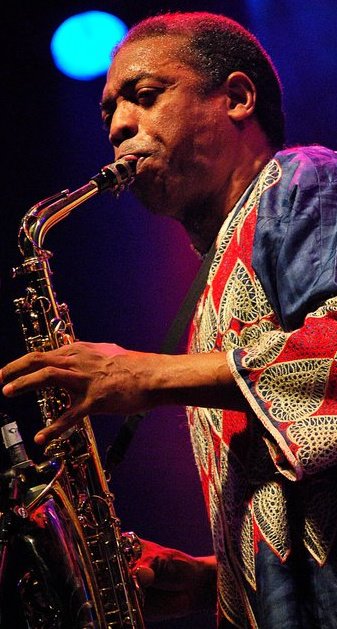
PERHAPS, if there’s an award for the most touring Nigerian artiste, Femi Anikulapo-Kuti would pocket that category permanently. From January to December every year, Femi and his Positive Force Band are touring Europe, America and other parts of the world; his schedule is usually fully booked. You hardly see him in the country, less granting interviews.
   However, if it has to do with struggle for the masses, like the January fuel subsidy saga, be rest assured that the first son of the late Afrobeat legend, Fela Anikulapo-Kuti, would find his way back home to Nigeria to participate. He’s a chip of the old block.
   Only yesterday, the three-time Grammy Award nominee marked his 50th birthday anniversary with a star-studded ceremony staged at the New African Shrine, Ikeja, Lagos.
    At the event, friends, family members and fans gathered to pay tribute to a man, who has brought so much honour and accolades to his fatherland. As expected, Femi treated the crowd to the best of his hits.
   Prior to the celebration, the Guardian Life had requested for a chat with him, hoping he could squeeze out time from his tight schedule. Eventually, the confirmation came, and as the saying goes, the rest is history.

THE New African Shrine was very peaceful this Sunday afternoon, with a group of young boys and girls watching the Super Eagles game against the Brave Warriors of Namibia. At another corner were two ladies slugging it out in a snooker game, while others sat round bottles of beer, puffing smokes.
   Femi was busy with another showbiz reporter when I arrived in his office; so, I had to wait in Yeni Kuti’s office. Few minutes later, he was ready to go.
    Clutching his trumpet while working his blackberry phone, Femi appeared very different from that man you see on stage; there was this calm about his looks. Though his skin still remains as fresh as ever, the grey hair was an indication that at 50, the boy is now a full-grown man.  
  “You are all making it such a big deal,” he said with broad smiles.
     How do you feel turning 50?
   “I’m quite indifferent o; I think I’m full of mixed emotions. Some times, I’m happy, some times, I’m sad. However, I never knew I would live this long definitely,” he said.
      Why?
    “Because I was a very reckless boy. If you had told me by 1982 that I would live up to 50 years, I wouldn’t have believed it. I had a bike then; I would go from Ikeja to Surulere in five minutes. If you saw me biking on the road… haaaaaa, I was very rough,” he stressed.
    You biked with kits?
     “Ha, which kain kits; kit ko, kit ni,” he quizzed. “Look, I was a very rough guy growing up, that’s why I’m full of mixed emotions today. Sometimes when I think of it, I’m quite surprised and happy. Some people around me are making it (50th Anniverssary) such a big deal and I’m forced to accept that it’s a big deal.”
   Left for the Afrobeat musician, his 50th birthday would have been like every other day. Thank God for his choreographer sister, Yeni, who seems to be the architect of the celebration!     
   “Sometimes, when I think of the wahala that comes with it… now, they want to do a big party for me. It’s going to be very stressful; I’m not sure I’m looking forward to it,” he said.
    With three Grammy nominations and a flourishing music career, cerebrating a 5oth birthday in grand style is not out of place for an artiste of Femi’s calibre. But for him, there’s more to life than counting success.  
    “If you are looking at it from that angle … I don’t look at things from that perspective; I like my peace, my quiet time and I don’t like dwelling on things I’ve achieved. I think they can be derailing; it makes you lose focus. ‘Oh, yes, Grammy Nominee!’ Come, is it Grammy that will take me to heaven, that’s if there is actually heaven,” he retorted.
   Are you saying you don’t believe there’s heaven?
   “There’s definitely no heaven,” he said confidently. “You know, when we were younger, they said heaven is up and hell is down. But when you know the world is spherical in shape, revolves and rotates at the same time in 24 hours, you will know that that place you point to, as up, will later become down,” he said, bursting into a prolonged laughter.  
    So, what exactly do you believe?
   “I just believe this world is a school and we are here to learn. If you find your ability to develop yourself spiritually, then you may be able to probably move to a different planet where you go through whatever you find there before you become godly.
   “You know they’ve just found another galaxy; they thought it was just this galaxy, but they’ve found another one. Maybe, there are several galaxies. When you go through science, you will be overwhelmed; how can you just narrow your mind down to God and devil, heaven and hell! It’s more than that for me.”
    That means you don’t believe there’s a Creator?
   “I’m not saying there’s no Creator,” he said in defense, but added, “If there’s that Creator, I don’t think it’s something I have to call every day of my life. Imagine someone calling your name over and over again! Like me, if they call me ‘Femi, Femi, Femi …’, I would say, ‘stop it, leave me alone!’
    “They won’t let the man (Jesus Christ) rest in peace sef, ‘Jesus, Jesus, Jesus…!’ Maybe that’s why we are suffering here. They call Jesus every time, they won’t allow the man to rest; maybe the man is giving us damnation from wherever he is.”
     To Femi, man can achieve a lot without depending totally on miracle.
   “For instance, I’ve never called Jesus in my life. Never,” he stressed. “Let’s look at it from the angle you pointed out earlier, those Grammy nominations wasn’t because of Jesus, but those who believe in Jesus were saying, ‘oh, Jesus gave it to you because he wants you to believe in him.’ I will still not call him tomorrow. Why should I call Jesus; do I know him?” 
    Then he turned around to declare that, “Ok, I believe he was a great man, probably died, but I didn’t kill him. Why should I beg for forgiveness? Those families that killed him, they should forever beg for forgiveness; I’m sure my family never participated in that incident. Since I wasn’t there, why should I be begging for forgiveness,” he quizzed again, pressing his phone.
     Generally, Christians believe that Jesus Christ gave his life for mankind, but Femi thinks otherwise.
   “They said Jesus gave his life for me, but when you go through that whole story very well, how did he give up his life for me? Even Jesus himself said on the cross, ‘God, you have forsaken me.’ When you go through that whole story, except you are not wise or you are too afraid to ask questions about that story, then you lose your self-confidence as a being.”
    He continued, this time, using himself as an example: “Yes, I call God, but not to help me out in an effort I think I should do on my own. I don’t think I will be a proud person if I know God helped me to succeed. If I know when I’m practicing, God is the one helping me to play my trumpet, I better leave it for Him to help me practice; why am I bothering myself? When you are making love to your wife, you call God abi,” he said rhetorically.
   Notwithstanding, Femi strongly believes there are supernatural powers and our ancestors, who are there for us.
    “I don’t think we are supposed to keep on nagging over this; you need to find your own being in this chaos. Where is your own effort as a being? These are the questions we should be asking.”
  
AT 50, nothing changes for Femi. Like his legendary father, Fela Anikulapo-Kuti, Femi remains the musician activist and social critic, whose voice goes beyond rhymes and rhythms.
    “Well, I know I’m old o. When I was 20, we used to call 50-year-old people old men. I have a lot of young people in my band and they are already looking at me as an old man,” he said.
   But when it comes to performance, “I think I’m even better now than when I was younger; then, it was difficult for me to place myself. Along the way, I’ve learnt a lot. I think I’m a better performer and artiste today; my maturity brought all these. So, I don’t think I’ve got to that stage where age is a minus for me,” he insisted.
    Though a lover of football, playing at 5o is a no go area for the musician, who spends more time performing abroad.
     “If I want to play football now, it will be difficult. I used to like to play football, but I’ve not played for about 25 years now. About seven years ago, my son called me to play with him and I had a tear. They just passed the ball to me, I kicked it and my muscle tore. For six weeks, I couldn’t move my leg, but when I watch those boys playing for Arsenal and Chelsea, I see they also suffer hamstrings and they are still young,” he joked.
    Which football club do you support?
    “Ah, I have many clubs; Enyimba of Aba, IICC of Ibadan … up Stationary Stores,” he screamed.
    His playing music was never an accident. Right from his childhood, he has always known that playing music is the way to go. With a musician father, it didn’t take long before that dream came to limelight.
     “My only problem then was how and when. But when I knew how and I saw how great my father was, I was like, ‘will I be able to live up to this heritage?’ I was a bit frightened.”   
    You had the blessings of your father?
    “Oh, my father always wanted me to be a musician,” he enthused.
    At the time Femi started his band, The Positive Force, many Nigerians, especially fans of his late father, wanted the young man to be a replica of Fela. While some complained about his fast tempo, others simply wanted him to sound like Fela, the Afrobeat legend.
    “That was a major problem in my beginning; a lot of people didn’t want to listen to me. For a good number of years, I was a complete write-off; my first album, they dissed it. We were not getting shows; I was going to disband so many times. Yes, I played under my father for six years: dressed like him, danced like him, did everything like him and I got bored; I couldn’t find Femi Anikulapo Kuti in that chaos,” he said, somewhat exasperated.
   Meanwhile, as at the time the Buhari/Idiagbon regime locked up Fela, the leadership of the Egypt 80 Band fell on Femi’s shoulders. That era provided him with opportunity to carve his niche.
   “I had to lead his (Fela’s) band for two years; I developed so fast. By the time he came out of prison, I had already composed lots of songs on my own. I needed to find my own voice, my own melody and my own rhythm. This was very traumatic for me but…”
    Any thought of quitting?
    “Never, even without patronage; my mother was the one that financed my band. But when we finished her money, my younger sister suggested I become a fisherman because we had no money and no food in the house,” he recalled.
    So, you fished at some point?
    “No, I didn’t, of course,” he said.


FEMI was on the verge of disbanding his group when the French Cultural Centre approached him with an offer to participate in a cultural exchange abroad. 
    “I called my band members to inform them that if we had to continue, they would have to play for free. Then, somebody came from France and that was how I got my international breakthrough through the French Cultural Centre, who took me on a cultural exchange in 1988; that was my first breakthrough. As at then, we were not having tours in Nigeria, but outside, my name became huge,” he said.
      Playing from one location to another, his music then was appreciated by the Europeans and Americans.  
    “When you look at it, the Europeans were the ones that gave me support and encouraged me to carry on. That fast tempo that I developed, the Europeans loved it. Nigerians complained that my music was too fast, that they couldn’t hear what I was saying. But I was like, ‘but you people are rapping, why are you complaining about my music?’ So, I closed my mind to the critics here and decided to face the Europeans who loved my fast tempo and beats.”
    Today, that fast tempo has become a big deal for the younger generation of Nigerians, who seems to have accepted it as a groove.
    “Bang bang band… became a hit and when I had Wonder Wonder, which was a hit, everybody said Fela wrote that number for me in closed door; they didn’t believe I wrote it. Fela had to come out several times to tell them I wrote the song on my own, but many people didn’t believe because it was so Felaish, it was a massive hit, the kind of music people wanted me to play,” he said.
    Till date, Femi still plays with a big band, not minding the high cost of managing such a large group. You begin to wonder how he makes his profits?
    “In the beginning, it was very stressful; some times, one or two of them would escape on tour. Nigeria has always been problematic; is it the no light, no water, no road, no money... there was a tour we had more than 20 shows; the drummer escaped in the middle of the tour and we had to improvise.”
     To salvage the situation, Femi came up with an idea of using the conga and the sneer drum, while the percussionist was playing the drum pattern.
    “We did it and it became a trend; we didn’t play with a drummer for a long time. However, that changed my composition again; it actually enhanced my creativity. Every time there’s a challenge in my life, I don’t dwell on it on the negative; I try to find how to quickly lift myself. I’ve not made millions touring because of the size of the band; by the time we buy tickets, transportation, feeding, salary… I will be left with just a little,” he said.
     Luckily, Femi is not materialistic; so he had little to save.
    “I don’t wear gold, I don’t have many shoes; I have like six or seven outfits made of adire. I rather invest on helping people, training my children and taking care of the Shrine than spending money on material things.”
     Though not your typical rich Nigerian man, Femi is comfortable.
    “People think I’m very rich, but I’m not; I’m just okay. However, I’m not poor; I don’ need to go begging or take a bank loan. I think when you start from a very poor situation, you know how to manage money. If not for my mother, I would have died because I had no money; whom do you ask for money? So, it kind of helped me to be a good manager.”

BEING Fela’s child is both positive and negative, depending on the side of the divide.
   “If you were with the poor people, you are great, but if you were with the snubs, it wasn’t really great. Even my wife, the family rejected me because I’m Fela’s son; the mother said, ‘the leopard would never change its spots.”
     To marry Femi, Fuke had to run away from her parents.  
    “My sister too had that problem; when their boyfriend’s parents found out that they are Fela’s children, they too asked them not to bring them to the house again.”
     But on the streets, “everybody loved us. In school, too, we had problems; the rich children didn’t like us because their parents were anti-Fela, but the poor children loved us because their parents were pro-Fela. The same with teachers; some were for while some were against Fela.”
   Were you ever punished because you are Fela’s son?
    “Well, I have this belief that some teachers over-punished me because they didn’t like Fela. However, there were some, who loved me because of Fela, but they didn’t give me any favour academically. They would call me, ‘ah, Femi, how’s your father?’ So, you could tell that they liked my father.”
     In areas such as Mushin and Ajegunle, which were considered Fela’s territory, Femi was at home.
    “I used to go to the poor people’s cinema houses like Rainbow and Jebako Cinema; we used to go to Plaza Cinema and others, which were for rich people; I preferred to jump school and go watch Indian movies at Rainbow Cinema. They loved us so much; I could walk on any bad streets then and people would shout, ‘ah, omo Fela, omo Fela …’ that was very interesting,” he enthused.
   At the age of 12, Femi was already riding his father’s cars to school, to the admiration of other kids.
    “When I started to ride my father’s Volvo and Range Rover to the Baptist Academy, I used to have a lot of problem with the police.”
    What was the experience like?
    “Ah, I was very popular then; I was notoriously popular,” he quipped.
   And Fela allowed you?
   “Of course, when he knew I could drive, he encouraged me. He used to say, ‘take the car, take the car,’ but my mother used to be very angry.”

TO Femi, the death of Fela was not as heartbreaking as the cause of his death.
   “It was difficult, but I knew he was loved. To defend him because he died of AIDS, that was really a difficult thing. For me, I didn’t see it as a big deal because I understood death; he could have died of cancer or anything. However, it was a new topic of death and people were talking about it. I had a feeling that probably, the government was trying to use it to blacklist him,” he said.
    Even at that, Femi was confident that no matter how the story went, people would appreciate Fela in death; he was confident that millions of people would come for his burial.
   “Fela’s death didn’t disturb me that much because he had a fulfilling life; sexually, materially, he had achieved everything. He was more than a great man; he was like a demi-god. So, I didn’t feel any kind of dejection. I was even kind of proud because of positive reports about him; journalists loved him. In fact, the Commissioner of Police then came out to say that there was no robbery for three days; he said robbers signed a pact that they won’t rob for three days in honour of Fela.”
    From his tone and body language, Femi seems not worried about death.
     “I know I’m going to die, so, death has always been something I’ve decided to embrace knowing too well that it’s going to come someday. I’m always psyching myself about death; is it going to be painful…?”
    Probably, the lost of his younger sister, Sola, was more heartbreaking than losing his father.
    “My sister’s death was a big deal because she was younger; it was unexpected. By the time she died, it was like a shock; it caught everybody unaware,” he said with a painful look in his eyes.

FORGET his life as an artiste, Femi is a true father; he loves his kids more than anything in the world. Aside from his six biological children, he adopted another four, who are presently under his care.
    “They are friends of my son and I’m taking care of them; I kind of adopted them because their parent’s were not well to do. I discovered that my son was developing faster than them and my son loved them. So, I asked to have them and train them in school,” he said.
    Asked what he would love to get as a birthday gift, the Afrobeat exponent jokingly said, “a private jet.” Then he came on again: “You can’t give me what I want; what I want is not material. I just want my kids to be happy; I want to be able to see that my kids have a good life. I want to be guaranteed that when I’m gone, they will be all right.”
    What about your wife?
   “I’m not married,” he said with a straight face.
    So, who takes care of the children?
     “I have people that take care of them and they have their mother’s families; my sister is also there for them. I don’t say anything about the mothers of my children because that’s their effort in sustaining the relationship.”
    He continued: “As much as I’m doing things for the children and themselves, they too have to put an effort to ensure that they love me enough to care for the children and myself. So, if they want me to live long, they should love me more; if I want them to be in this relationship, I should love them more. The children cannot fend for themselves; we need to give them all the love and protection we can.”
    What’s your biggest asset?
  “My children; nothing comes before them. I needed my career to sustain my children. If you are a good parent, you would let go a lot of things for the sake of your children.”
    Your happiest moment?
   “When my kids are happy and laughing; they determine my mood. You know they come from different mothers; so, its difficult to keep them united. You have to teach them to be there for each other now, so that in future, they would be there for themselves. They shouldn’t let their mothers jealousy to come between them,” he said.