Friday, 23 December 2011

I Am Now ‘Prince of Nigeria’ … I must hold on to the great vision until our country is delivered from poverty and oppression…


 BY CHRIS IREKAMBA AND CHUKS NWANNE


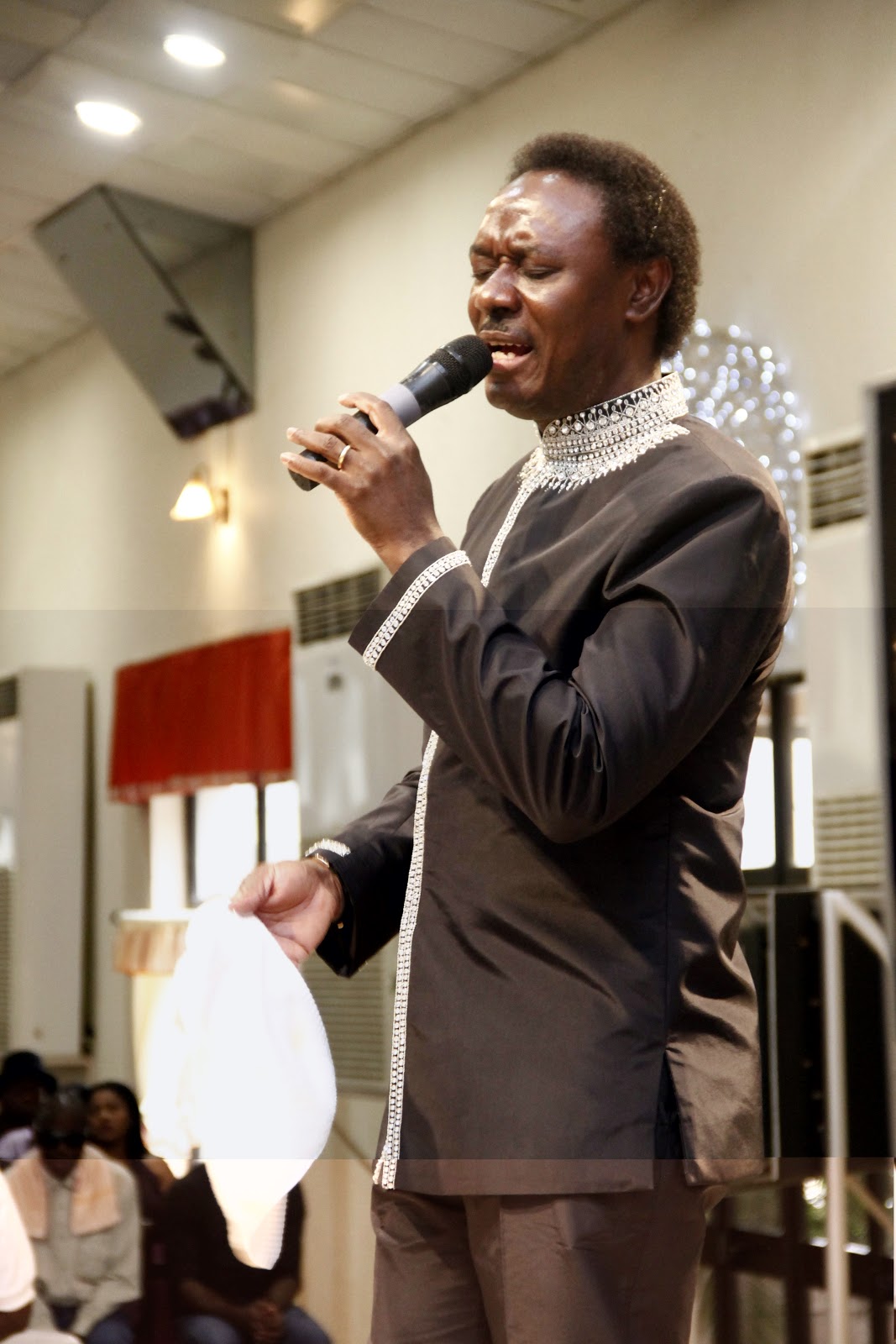
Unlike the hustling and bustling that enveloped the premises last Sunday when Rev. Christ Okotie celebrated his 53rd birthday, the Household of God Church was quiet this afternoon, with the security guards at alert, yet friendly. However, there was no long interrogation before we were ushered into the Household head’s simple but detailed office; he must have instructed his men about the visit. Dressed in simple African outfit, Okotie arrived few minutes later in a red Range Rover Sport SUV, ready for the interview that touched on almost all aspects of his life. Excerpt:     

How do you feel on your birthday?
  I celebrated 53 years as a man on the face of the earth. But more significant was the fact that on that day, I was ordained Prince of Nigeria, which is a prophetic appellation that actually comes from my book, The Last Outcast. In the book, the protagonist is a man by the name Sam Uyota. He will in about 600 years from now be a Pastor in Household of God. He will reveal the coming of anti-Christ. Now, in spiritual things, though I’m the present pastor of the Household of God, I cannot stand in that office to speak about what Sam Uyota has done in the book, except after a period of about 12. So, in prophetic numerology as they are juxtaposed Biblically, Sam Uyota, who is really the Prince of Nigeria, takes the first 12 years of my ministry while I take the next 12 years. That’s why I couldn’t take that title until my last birthday; this last birthday culminated into the 12th year and if you add both years together, it comes to 24. What has happened is that, now, I’ve taken his title, so, I can communicate the last revelation of the anti-Christ; who he is, where he is coming from, the signs that shows when he is coming. I’ve spoken about those things, but now that I’ve been ordained in that prophetic office, there’s an impartation from heaven that will bring the enablement to complete the story, because the story of The Last Outcast is not complete.
Any continuation of that story?
  Oh, definitely, there’s a sequel to it. But it is important that in fulfilling all righteousness, I must be ordained into the office. I cannot take his name because my name is not Sam. It’s just like Jesus and Adam. You know that Jesus is the last Adam; he stands in the same office as the first Adam, but his name is different, yet they have similar responsibility. Today, if you go to the spiritual realm and say you want to get in touch with the Prince of Nigeria, all spiritual activities will be directed towards me.


“Oh yes, I was young; I was 21 at that time and I had so much money, but no parental guidance because my Dad had passed on and I was left to myself. God just kept me away from drugs because He had already decided I was going to serve him. But I did a lot of damages to myself; thank God for the blood of Jesus Christ and the deliverance that we got through his name.”
And the ordination   
   The ordination was performed by George Amu; the general secretary of CAN (Christian Association of Nigeria) and a senior colleague in the ministry. But you see, he is the man that fulfilled the righteousness of laying hands on me; you can’t receive that, except heaven has already given it to you. When I was writing the book 12 years ago, the spirit of God already communicated to me what was going to happen in the future and I didn’t use my name; the book doesn’t say it’s Christ Okotie, it says it’s Sam. So, the pastor’s name in that book, who is the pastor of Household of God, is Sam Uyota.
  Now, if I’m going to pick up on that, I have to stand in the same office with him. I already do because I’m the pastor of The Household of God, I can’t use his name, but I can use his title, which is what I’m using now. Just like the title of Adam; Jesus used it, even though his name is Jesus.
  The first time Jesus appeared after his birth, he was 12 years and that’s the number. That’s why it’s prophetic for us to do this in block of 12 years. So, it’s something I had been waiting for and when the time came, another servant of God came here to follow biblical procedure to lay hands on me to begin the work. So, it’s a spiritual reality for me, not a secular responsibility. My secular responsibility is wanting to be president, but this is a spiritual responsibility ordained by God for Nigeria and the rest of nations.
Is the Christian Association of Nigeria (CAN) involved in this?
  Well, CAN is not involved in the goings on of churches; it’s just an umbrella for churches to ensure they are given the right space to operate and to make sure that matter that concerns the church are properly presented at the national level. But they don’t interfere in the goings on in the ministry. I didn’t write a letter to anybody about this because it’s unnecessary. But this is a spiritual matter; those, who are spiritually sensitive, who understand the modus operandi of the spirit and what God is telling Nigeria now, will understand what I’m talking about.
Why was Bishop Amu the only clergy present?
   Because the other clergies were not invited.
Why Bishop Amu then?
  Oh, I invited him. Let me explain how these things work. When you are called to be a pastor, Jesus gives that office to you; he calls you into that office; but before you can stand in the office, someone in the church has to lay hands on you. If you read ACTS chapter 13, Paul and Barnabas were called to do certain work for God, but the church had to lay hands on them to fulfill that mandate that’s just the way it is. So, whenever the Lord tells you to do something, He will provide a minister or somebody within the body of Christ that will take up the responsibility.
Have you ever doubted the possibilities?
  Not at all, because, it’s not something that is dependent on what is going on politically; it is not dependent on the opinion of the people. I work for someone; I work for Jesus and today, my life testifies that he has been faithful to me. In 1987 I became a minister, it was the same reaction. So, I understand the concern, but the truth of the matter is that those who know me know that once the Lord says it once, I hear it twice. And I must hold on to this vision until our country is delivered from the shackles of poverty and oppression.
 
Me and music
‘I was 21, doing music… and I did a lot of damage to myself’

I admire the new pop artistes, their brotherhood; though they copy each other a lot

Is there any place for music now?
  Well, we use it as a tool for worship; music is very powerful when it comes to worship. I’ve had the privilege of writing songs; most people don’t know that I’m the writer of some of the songs they sing in their churches across the nation. I look forward to recording my worship songs someday.
Do you still have the collection of your old recordings?
  Oh yes, they are the artistic works of Christ Okotie. I keep them where I look at them as creative works. 
Do you still listen to them?
  Sometimes. I refer to them as works of creativity; sometimes I listen to them to find out how I’ve grown musically. Essential in music, what makes the difference is the lyrical content; the melodies, the harmonies and all the instrumentations are basically the same. In some of the songs I did, I think the messages at that time were things I felt. If I’m to write a song today, the lyrical content will be different, but essentially the same Christ Okotie’s style.
Are you still in contact with Felix Liberty, Jide Obi and others? 
  Oh yeah, Felix is a minister now in Benin while Jide is abroad.
What is the relationship like?
We are friends because they are Christians. Like I said, Felix is a minister and Jide is somewhere in England.
 How do you see the pop scene?
  The genre is still basically the same, just that it’s more of dance music now; you don’t have the music that people will just sit down and listen to the composition. Though there’s a lot of originality, only few artistes are really that creative and I discovered that they are constantly copying each other, too. There are some of them that are quite creative, but I won’t like to mention names.   
Does that mean you don’t believe in their works?
  I believe that they are artistic creations and they serve certain purpose in the creative industry. They need more encouragement and better facilities. When you listen to one song, it sounds like three of four songs you heard lately; so, there’s that plagiarizing; they are constantly copying each other.  So, in the creative space, there’s not really much that have been done. But like I said, some of them are good.
Your favourite artiste?
  I don’t want to mention names because it is a competitive industry. One thing I like about the industry today is the fact that there’s brotherhood that has arisen from the collaborations. So, you find this artiste singing with the other artiste, as it’s done abroad. So, it has created a brotherhood and friendship among the creative people in the industry, which is commendable.
The industry now is more lucrative than your own time, how do you feel about that?
  I don’t feel anything because I was the highest paid artiste in my time. I had so many opportunities that a lot of artistes didn’t have because I started a type of music that is unique, so, it drew a lot of people to me and that gave me a lot of money. I don’t have any reason to complain because I was very well paid. Now, the industry is developing and artistes are not making money from records sales as they are making from endorsements. When you look at the market, they don’t have enough distribution networks, but I’m glad to see that through live shows, concerts and the coming of multinationals, artistes have received endorsements that have helped a lot of them to stabilise. That’s a very good thing and I thank God for that; if not for that, we would have been facing a lot of difficulties by now.
Any regrets playing music?
  Oh yes. I was young; I was 21 at that time and I had so much money, but no parental guidance because my Dad had passed on and I was left to myself. God just kept me away from drugs because He had already decided I was going to serve him. But I did a lot of damages to myself; thank God for the blood of Jesus Christ and the deliverance that we got through his name.
Damage to yourself?
  It’s difficult to be independent at that age when you are exposed to a lot of money like I was. I didn’t have a solid religious background that would have stabilised me because I was neither here not there as a Christian. But God in his mercies kept me and sustained me and that’s why I didn’t stay too long in the industry. By the time I did my fourth album – which was within a space of about two or three years – I was already fed up. People thought I became a Christian and stopped playing music. But the truth is, I stopped playing music, and then I became a Christian; I recognised that if I didn’t, it would destroy me completely. In 1982, I held a press conference in Enugu to say I was quitting and several months later, I became a Christian; that was 1983.
If not for the calling, would you have remained in the industry?
  I probably would have been involved in Christian show business, trying to help young artistes. I probably would have done that and combined it with some other things that I have interest in. Yes, I would have.
Any influence from Michael Jackson?
  I wouldn’t say at the beginning that Michael influenced me; I was more interested in Stevie Wonder because of his vocal ability. As a singer, I was drawn to Stevie’s ability to sing and control his voice. It was later on when Michael came up with Thriller that we saw his ability to dance and his showmanship, but I didn’t consider Michael a good singer. For me, he was more of a dancer and a showbiz personality than a singer. Stevie Wonder had greater influence on my singing than Michael.

My encounters with Jesus

How he cheated death
I had a near death experience in 1983 in Kaduna. I went to do a valedictory show there and was poisoned. It was as if there were some objects in my stomach. The doctors had said they couldn’t do anything and suggested that I should be flown abroad. Before leaving school for the show, a friend of mine, Ezekiel had told me that if I run into any problem, I should call Jesus. So, at that point when the doctors said they couldn’t help me, I decided to call on Jesus. I promised that if he helped me, I would serve him. Few minutes after saying that, I felt relieved; like something left my body. In fact, the nurse was afraid when she saw me coming because he thought I was dead. Funny enough, when I came back to Lagos, I didn’t fulfill my promise to God.
What did you do then?
  I gathered my friends in a niteclub run by Ben Bruce to tell them my experience in Kaduna; drank and celebrated my survival. I didn’t keep to my words for about nine months until Jesus came to my house to speak with me for about 12 hours. I was arguing that I was a good man. In the middle of that, Jide Obi came in around 4am; he had been standing in front of my door because he thought I had a visitor. So, when he walked in, he asked whom I was talking to, and I used that opportunity to run. He asked me to drive him home and along the way, I told him about my experience.
How did you contract the poison?
  From a drink; they hosted me that night and Balamila and his band backed me on stage There were so many people and I got up several times to go and dance and talk to people; no one knew how my drink was poisoned.

 ‘Me and my women’
Did you have a girlfriend in your days as pop star?
 I wasn’t doing any crazy thing, I had only one girl friend; I didn’t do those crazy things that other musicians do.           
Before your marriage how many girlfriends did you have?
  I only had one girlfriend at a time who would always be with me, because I was always at home.  Some people enjoy attention and all of that, I don’t enjoy such. I’m a publicity shy person.
What do you miss about your first marriage?
  No comment. 

Dressing and the pulpit
‘I dress to communicate relevant God’
Your style in terms of dressing
  Christianity is a relationship and not a religion; that is how we define it. It must be relevant, every age redefined the public persona of Christians leadership. You can’t have a Christian leader who is in an age where he acts like a social miscreant; for instance, Jesus and John the Baptist lived in same era; one dressed like somebody from the prehistoric times, the other one dressed like one from the future. Jesus dressed like somebody who was futuristic; his clothes were good that at his crucifixion the Roman soldiers took it. But here is another minister, John the Baptist, his dressing was like Elijah of old. Because the message he was communicating was reminiscent of the anointing of Elijah. But Jesus was communicating a totally different message for a new age, and for a new era. 
  The clothe we wear would indicate the age in which we live and that God is not an antagonistic God; that the ages are His own creation. That’s why when I became a pastor I started dressing like people of my own time. If Jesus was dressing any different you won’t have Judas Iscariot to identify who he is because his clothe will give him up. But if he’s mixed up with other of his disciples you couldn’t tell who was who. So if I stand in the midst of Nigerians of my own social bracket, you can’t tell the difference. Because what we are trying to communicate is relevant God to a relevant message so you don’t have to think when you come to serve God you have to act like you are in the 60s, when we are in the 21st century. That has misrepresented the gospel and that is why the gospel has not been so readily accepted. But all that is now changing.
How often do you fix your jerry curl?
  My hair is what you are talking about. It is stylish, it’s very contemporary now; but not jerry curl.
But you maintain that too, how often?
 As often as is necessary but I cannot tell you that it is maybe once a day or twice a day. Just as I keep my body clean, I keep my hair clean; it doesn’t require anything beyond that.
Would you be happy seeing your members in similar fashion?
  They are at liberty to wear whatever cloth they want to wear within the confine of decency. I don’t dictate to them what they should wear because it is the Bible that tells us what to do not the pastor?
If you were to describe fashion what is it to you?
  Fashion is a whimsical expression… I think it’s of personal preference; it’s very subjective. For me that is just what it is, an outward demonstration of the whimsical preference in the area of clothe or personal style.
Who is your designer?
  I don’t have any local designer. No, I used to like this one that I’m wearing; this is Nigerian made. People just make them and send to me. I usually wear European clothes like Gucci, Dolce & Gabbana, among others. For me, if I see something that is good, it doesn’t matter who the maker is.
Fashion accessories
  Only wrist watches. I don’t wear gold, chains and necklaces; I don’t wear those things. I’m a collector of wristwatches. I like wristwatches that is why if you notice very well our logo is a clock. I have all kinds of watches.
What is your choice of cars?
  I like car because of the privacy it provides for me, that is why I don’t like being driven. I drive myself; even when I’m going to functions, I drive myself. Even when I’m in a convoy I’m driving myself.  I’m going to be the first president that will drive himself. It provides for me that privacy.
    I have all kinds of cars. When I was younger I was into sport cars such as Lamborghini and all that; but now, I buy the bigger cars such as Mercedes Benz, Range Rover and all that. But the car that you will probably be seeing me with is Rolls Royce and something like that because for me, it epitomises the privacy of style.
Perfumes
  I don’t tolerate perfumes a lot. I have to be specific about what I wear. It depends on what is in the market at a time. Sometimes it irritates me.
Sport
  I have always been a sports person. When I was in Edo College I was a judo coach, a national sport commissioned coach. So, if you look at the record, you will see my name there as a chattered coach in judo. I love martial art exercise; it is part of my life.  God has given me youth. When I said I belong to the Methuselah clan… sometimes when I tell people they don’t believe it. But I have been around for a while. People like me stay long because we have work to do.

Thursday, 22 December 2011

Ejike steps into new grounds with Icon Mag

Omiko Awa


HAVING featured in almost all the genres of the art, Prof. Bob Ejike, a multi-talented artiste that made his début in acting in the rested TV drama, Basi and Company and has over 40 home movies aside six albums to his credit, is currently working on a new project — The Icon, a society and life magazine. The prolific writer who at 13 shared column with veteran Ben Okri, a Commonwealth Literature prize-winner, in the defunct Drum Magazine, presently frequents Uganda promoting Nigerian and African movies. He speaks on his latest enterprise.

PRIOR to 1982 when his presence in the entertaining industry was established with the making of the award-winning film Echo of Wrath, the movie that contributed to the establishment of Nollywood, Prof. Bob Ejike had been featuring in a TV drama, Basi and company. And after the debut, he moved into teaching, as a way to augment his earnings from the theatre. He says, “ I was in Nollywood for many years. I made the first Nollywood film Echo of Wrath in 1982.  The film started the evolution called Nollywood in the Nigerian film industry.”
   Because of poor pecuniary rewards in the movie industry then, Ejike combined acting with teaching.  
  “I am a restless soul. I like moving and discovering new things and places. I spent 22 years teaching in a University in Italy and now, I live in Kampala, Uganda, where I run a number of recording studios and try to help indigent artistes in the country.”
  But what transpired within the period you left the stage. “Nothing really, for even while I was acting, I was teaching; I have always been a teacher. When we started Nollywood, the industry was not financially rewarding or strong enough to sustained anybody, as it is today with artistes making millions of Naira in it.”
   “Though, I have found new challenges in Uganda, mentoring upcoming artistes, promoting Nigerian culture and serving as a bridge between Nigerian and East African countries, he continues,  ‘I can still play active roles in Nollywood, if I’m called upon to do so. However, I have contributed my quota in the industry by doing about 40 films and worked in the various aspect of the industry. I ‘m one of the very few people that engineered the revolution and have also gone the extra lenght to advertise it abroad. Though, not much of that is talked about, because you don’t see the person from the country; I must say, for our films to go international a lot of public relations were done to make the Europeans to watch them. It was not an accident, efforts were put into the conviction.”
   But why go to Uganda when you can be at home to help Nigerian artistes? “We are the richest country in Africa. We have the capabilities to do things by ourselves, but the revise is the case in Uganda.  I have more work to do there than in Nigeria, where you make a five-minute recording for N1.5 million,” he says amidst laughs.
  Knowing the complex nature of film industries across the globe, Ejike who has dealt so well with the industry will not waste his time to compare one country’s film industry to the other, not even when a particular country’s film industry is still at its infancy.
  “Firstly, I will never compare any nation’s film industry with another because each nation has its distinct history, cultural backgrounds, traditions and others. I wonder why people do it; some even compare Nigeria with America and Nollywood to Hollywood without thinking of the billions of Dollars pumped in Hollywood every year. They just run down Nollywood as not good enough without knowing the industry is striving on self-effort — no sponsorship.  Though, the industry may have its bad sides, for we can’t throw away the bath water with the baby.”
  

 “I must say, for our films to go international a lot of public relations were done to make the Europeans to watch them. It was not an accident, efforts were put into the conviction.”
HOW is the country’s entertainment scene like?
     “Uganda has a booming music industry, which is supported by the people’s tradition of visiting places and spending fun time outside their homes. Besides, the security situation encourages people to move at night. Artistes work every night including Sunday; in fact, there is an incredible merriment in the country.  There is an active nightlife with many clubs in operation. Clubs have a performer and there are usually live bands every where.”
  “At weekends, there are always big shows with popular artistes coming together to performer.  It’s difficult to find a show of one or two artistes, as the system allows 20 or more of them to be on stage in a show. The people have a tradition that sustains large concerts,” he enthuses.
    However, in the midst of this pleasant situation, Ejike notes, “their recording studios are not developed because of the activities of pirates. They don’t even know it’s a crime! Pirates put out adverts and dub any music openly. If you bring your music to a shop, they put it in the computer and dub it for sale. Artistes don’t target record sales as a way to stardom because of pirates, but depend on stage performance, which give them more money.”
   Ejike whose latest work Bright Eyes is enjoying massive airplay in the Nigerian airwaves states, “artistes even give their works to pirates as a way of advertising them.”
    But pirates go for popular music. “Yes, in Nigeria; but in Uganda, they popularise artistes’ work. In fact, artistes depend on concerts to make money; that’s how the industry works there. However, it’s working for them because there are many artistes and events; it’s not like Nigeria where things don’t work … our country is difficult.”
 Ejike whose stay in Uganda has facilitated some popular Nigerian artistes to perform in the country says, “I’m culturally the bridge between East and West Africa. I’m Emeka Ike, Ramasey Nouah, Pete Edochie and others. I’m Nollywood; they call me Nigerian film. They refer to me as, ‘Chi Nigeria’, which means Nigerian film. My presence in the country has made artistes such as 2Face Idibia, PSquare, Adim Williams, Genevieve Nnaji and others to visit Uganda. I’m, in fact, the most popular public relation officer of Nigeria; I even do more PR jobs than the embassies.”
 
    DO you also promote movies?
  “Yes, of course. I’m involved in a project called the Ugawood, which is aimed at extending the Nigerian successes of Nollywood to Uganda aside incorporating local filmmakers. With the project, I do not only promote Nigerian films, but African films across the globe.”
   The Bright Eyes crooner, aside serving as a bridge between Nigeria and East Africa countries, is planning of venturing into another area of entertainment, publishing  Icon magazine, a society and  celebrity magazine.
  “We intend to start publishing the Icon, a magazine that publicises the achievements of Nigerians. We have spent so much time, criticising ourselves, but now, we want to peep into those things that make the nation thick and the people behind them.”
   “Nigerian is one of the greatest nations in the world and we want to highlight those things that make us great and not the death traps on our roads, erratic power supply, unemployed youths or untapped resources; we don’t want to publish those things you would remember and you would want to cry, but to look at the positive side of the country and its people. We shall be focusing on achievements and people behind them and not necessarily famous people. It’s going to be a general read magazine”
  Would this not be a digression of what you are noted for? No, I have been a writer right from my childhood days. I started my career as a poet and then child writer. I shared a column with Ben Okri in the Drum Magazine, now rested, as far back as when I was 13 years. And ever since I have written for several newspapers, including The Guardian and a number of international tabloid and magazines. I publish books; besides, I studied Literature and Communication, so, I’m still within my field. The digression, in the real sense of it, is music and not writing or journalism; though people know me more with acting and music than with other genres of the art.”
    
OUTSIDE from promoting local artistes, Ejike who still makes out time to perform on stage in Uganda says, “I’m one of the most famous artistes in the Uganda and East Africa; so, I’m always on stage. There are stages for artistes to work over there, but I don’t know where our artistes work in Nigeria. I have been going around in the country to find a stage, but I haven’t seen any; I wonder where Nigerian artistes work, may be in Alaba market!”
   Your expectations of the magazine. “I want to keep it standing, give information and entertain.”
  

Wednesday, 21 December 2011

Land Feud In Ladipo Market As Owoyemi Family Demolish Houses, Churches


By Tope Templer Olaiya and Omiko Awa

The bizarre nature of Lagos and its land ownership system, which sometimes rest on the shoulders of land speculators and feuding families, was at play again yesterday when a group of people from one Owoyemi family stormed the Ladipo auto-parts market at Toyota bus-stop, Oshodi-Apapa Expressway, to claim ownership of the Odo shanty settlement.
  Arriving with thugs popularly called Ajagun-gbale (land grabbers), buildings, including churches erected along the border of the canal beside OK Foods were demolished and valuables confiscated in the bid to carry out a purported court order giving ownership of the land to the Owoyemi family.
  A resident of the area, who was picking through the rubbles when The Guardian visited, said his father bought the land and he had lived there since 1968. “The portion of land belonging to the Owoyemi family was already sold off to OK Foods long ago. Sometime in 1998, the family came around wanting to claim possession of this place, but we took them to court and they were fined. They even paid all the damages incurred at the period.
  “We were, however, shocked to see some thugs invade the area two days ago, saying they have a court injunction to demolish building trespassing on their land. We didn’t see the court sheriffs and they were not accompanied by policemen. They just came  with a jankara judgment and ejected us from our respective homes.”
  Another resident of the area, Alice Oke, bemoaning the forceful ejection and unlawful demolition, said “Christmas is coming, we have nowhere to go, there is no money and all our belongings have been destroyed not by the government, who holds the land in trust, but by impostors. They came without court bailiff and policemen to perpetrate this evil at this time when the economy is biting hard on everybody.”
  Though most of the spare-part traders, whose shops were surprisingly not touched, refused to comment on the demolition to avoid confrontation with the Owoyemi family, the few that spoke said they are now occupying their shops in fear as some of their landlords have been displaced of their accommodation.
  Kenneth, one of the motor part dealers, said the destruction of the residential houses and churches is ideal since the whole area had been demarcated as an automobile market. “As much as I sympathise with them for the destruction of their houses and places of worship, I strongly believe that the ideal thing is to relocate the residential houses out of the market.”
  On the possible destruction of their shops, he said it cannot happen as the traders are members of unions and associations; and before anything can be done to their shops, it would be duly communicated to them through their executives.
  However, some traders are still of the view that the Owoyemi family may come at night or when most of them may have traveled to their villages for the Christmas and New Year holidays to pull down their shops, especially those belonging to the opposing family.
  A trader urged his colleagues to remove valuable items, especially money from their shops, as such surprise attack often come along with looting of wares.
  Some of the churches affected include The Apostolic Church, the Cherubim and Seraphim church, the Eternal Church of the K&S Aladura, and Awamaridi Praying Band.


African, a reawaking call to African wears and arts


 By Omiko Awa

AS the aphorism goes, as you are dressed, so you are addressed, the book African Fabrics and Arts for Corporate Africa: Our Identity, Unity and Economic Revival raises issues of cultural identification and calls captains of industry, opinion moulders and policy makers to look into making Africans dress African in all areas of life, including workplaces.
 Written by Chinasa Ugoala, the book purses an advocacy to adopt the African fabrics beyond the frontiers of fancy and the glamour of fashion. She expounds how dress functions as a compelling political language, comparable in eloquence and potency to words of skilled orators or the writing of persuasive propagandists.
   Hinging her views on that of Hildi Hendrickson, the author states that European fashions are designed to sweep away the culture and traditions of colonial Africans. She informs that Africa with its numerous designers, making waves in different aspect of fashion industry across the globe, has come of age to break free from the cycle of defeatist mentality and dependency on non-African for virtually everything.
   Chinasa queries the authorities of those that determine what makes a corporate wear and asserts that European wears are some of the badges or emblems of continuous slavery.
  The 134-page book maintains that each generation has the power to determine its fate and decide what the next generation would be, and if we must be free from modern slavery or imperialism, Africans must reclaim their cultural identity. 
  She asserts that culture reflects the inner consciousness of who we are, and how that identity is manifested through an outward expression of how we feel about who we are, which is translated and expressed through our dress, the use of our arts and other products manufactured locally.
    Chinasa informs that Europeans line their cloths with nylon fabrics because of the intensity of the cold weather, which does not suit our climate, but rather subject us to discomforts. She infers that Europeans make their dresses without due considerations to Africans and their weather and calls for our leaders to note this and make our designers to come up with cloths that tell whom we are and suit our weather.
  The author notes that countries such as New Zealand, China, USA, South Africa Republic and others, have manipulated the western fabric to suit their cultural agenda and urges Nigeria to emulate them.
   Medically, Chinasa states that the tie commonly worn by men as part of European dress generates heat and disturbs blood circulation around the neck; a situation that is often not palatable to hypertensive patients. On the use of stocks, she notes that the footwear is worn by the westerns to keep warm and unfavorable to African climate because it makes the Africans to be susceptible to fungi infection such as Athlete’s foot.
  Apart from the beauty and flexibility, the book exposes the meanings of the various patterns and colours used in African fabric as follows: Pink it says, is associated with tenderness, calmness, pleasantries and sweetness; Purle (ritual and healing purpose), Maroon (power to repel malevolent spirit), Black (spiritual maturity and potency), Gold (royalty, wealth, glory and spiritual purity). Unlike the colours the patterns are used to express philosophical ideas or mantras like Isana, which means ‘he whose house is on fire does not go to sleep’; Oni­­­,  ‘the stream may dry, the water course will remain’; Sekeseke, ‘he who has nobody to tie him up should never go mad’. The author notes that these are everyday lessons, which wearers of African fabric carry alone.
   Highlighting the various economic benefits the author explains that adopting the African cloths, arts and decoys in all areas of our life will help revive and develop the textile industry, promote tourism, create job opportunities, alleviate poverty; reduce the dependency on oil and open up our mono-economy.
   Published in 2008, Chinasa through the book calls on Africans, especially Nigerians to brand its fashion and art to form part of the universal trend that would bring out the African consciousness, revive African culture and raise socio-economic values.
  The project is laudable, but Chinasa in her copious quote of the Bible narrows her readership. For she should have balanced this with quotes from other religious books, knowing that most things in this part of the world, even in academics, are structured to ward this divide.
  Also, it should be pointed out that banks are not among the highest employers of labour as she makes us to believe in page 43, rather this sector is a major player in any country’s industrialisation as they make funds available, but in term of engaging labour they take the backseat.
   Lastly, the prints displayed as Tiv cloths are not true, they are rather for the general use of the Igbo and their eastern neighbour, this also reflected on the names those prints are called. The Tiv traditional  cloths are striped in nature and are made of cotton.
 Despite this, it must be noted that Chinasa has created agenda for our leaders to discuss.

Tuesday, 20 December 2011

Nigeria’s problem is an issue of sibling rivalry — Modupe Oduyoye


MODUPE ODUYOYE, a linguists, is a retired Literature Secretary, Christian Council of Nigeria, and for 10 years, Consultant on Literature Project for Christian- Muslim Relationship in Africa. This author of several books, heads SEFER Books Ltd, a publishing house in Lagos. In a chat with OMIKO AWA, recently, he talks about books and other issues affecting the society.


Background 
   I studied English language, Latin and History at the University College, Ibadan, from 1954 to 58.  I actually applied for Special Physics, but was admitted for the Arts, which I ended up studying for 4years. And upon graduation, I taught English language, English literature, Latin and History at Ibadan Boys High School for 5yrs, during which I became the general secretary of Christian Movement of Nigeria and also the travelling secretary. While acting in that capacity, the president Prof, Idowu advised I study Theology, which took me to Yale Divinity School from 1963 to 66. My background followed me to the school because from 1960 to 1962, I was teaching Yoruba on part time basis for the Extra Mural Department of University of Ibadan while still with Ibadan Boys High School, to Yoruba non-native speakers, and the questions they raised made me to unwound what I know of the Yoruba culture, of which years of studying and teaching English literature and English History was distancing it from me. In one of the days, I was teaching the US-Peace Corps Yoruba, Dr. Williamson who had just returned from Yale with his doctoral in Linguistics requested to sit at the back of my class and after listening to my lecture asked of the books I used for my notes. I said, ‘I write them myself and he said since I’m ready to go to Yale, I should go and see Prof. Block of the Department of Linguistics when I get there.  On getting to the school, I did as instructed by Dr. Williamson; met the professor and registered some courses.

But you never studied Yoruba why were you teaching it?
   Now, this theory of things must be studied in school to be practised is very strange. Please, where did Bill Gate studied computer; who taught the first architect, architecture; or the first medical doctor medicine… who? In CMS schools in Yoruba land in Nigeria, you are taught English and Yoruba sponsored Studies. Ajayi Crowther took part in the translation of the English Bible into Yoruba and in the writing of the autographs of Yoruba and Nupe languages, he was a linguist, a Bishop and a missionary; which school taught him those languages. But, because every missionary is expected to learn the language of the people he is preaching to, he learnt them through the people.

 Why special interest in Yoruba language and Yoruba names?
   One, because I’m a Yoruba.  Secondly, to make it easier for the foreign students I was teaching to freely mingle with the locals because they have to know the people they were to dealing with.  I told them that Yoruba names are almost like a sentence, for instance Ade s’ ola, is a sentence; Awo l’ owo, is a sentence; Akin de le, is another.  So, I said wherever you hear a Yoruba name, just wait and ask for the meaning. And you will find subject, verb and object, very many times.

Why were you also interested in Greek when the language is considered dead?
    I picked up Greek because it was necessary for the study of the New Testament Bible in its original form. I started studying Latin right from 1947 in Ijebu Ode Grammar school till 1963; I was teaching it at Ibadan Boys High School. Now, it happened that the people, who propounded theories for Comparative Linguistics, were Europeans such as Sir Jones, who studied Greek and Latin in England. He was English and was posted to India as Administrative Officer, which exposed him to the people and their language.  With this situation, he began to compare Sanskrit, Greek and Latin, and finding similarities and differences of the languages, he began to give lectures on his findings, which was what we studied as theories. Knowing that these languages are interrelated, he groups them as Indo-European languages. These were the languages we were taught in Comparative Linguistics.
    However, upon graduation, having studied Hebrew, Arabic and Greek, I began to see the interrelatedness of our local languages, which led to my investigation on the common origin of all languages of man. I started with Yoruba and later English because it’s our lingua franca, but while growing up I mingled with Igbo children in school, which made it possible for me to pick one or two things from the language and at 12, I added Latin having known Hausa from 5 years in Jos, where I lived with my parents. This investigation led to the writing of “Sons of the gods and the daughters of men and Afro-Asiatic interpretation.” I ‘m looking at the event of Genesis 1:11 from the Afro-Asiatic world, which includes Middle East, Ethiopia, Lake Tchad, Hausa, Angas, Tiv, Igbo, Ewe Zulu, Yoruba and others.

Are you saying we are all from a common origin?
  Yes, yes, and yes; and researchers have proved that too.  For instance I read that until 6000 years ago no continent except Africa was populated because it’s the only place you get the largest area of warm climate, and life survives easier in warm climate. So, life began in Africa and from here, spread to other parts of the world through the horn of Africa.

With this while are Nigerians fighting themselves?
   It is because brothers in many families fight themselves; have you not heard of sibling rivalry?
Are you now saying the political rivalry in the country is natural?
  It’s a case of brothers fighting each other; so let grandmother Ani or ala (the earth goddess) settle them. Let grandmother separate them. Let her intervene because we are all going back to her. Nigeria’s problem is an issue of sibling rivalry, so let ala settle it.
 

 Would that not mean going back to worship the earth goddess (Idol worshipping)?
   Which is the idol, if you go to the Bible, book of Job Chapter 2, it says, “naked did I come from my mother’s womb, naked will I return either.” What is the womb of Job’s mother? This has always been my question to students of Theology in Nigeria and GCE comprehensive question on Christian Religious knowledge for secondary school students in the country. What will be the answer? The earth you mean… is that paganism. No, it’s knowing what the Bible says, and I wonder, how many people know what’s in the Bible? For most Christians in the country prefer to read the translated version to the original Greek version of the New Testament or the original Hebrew version of the Old Testament. I will advise them to study the original versions, so that, they wouldn’t fall into the mistakes of that teach in Israel that came to Jesus at midnight to ask what he shall do to inherit eternal life. And Jesus said, “you must be born again,” and he said, “ how can a man go back to his mother’s womb to be born again,” and Jesus said, “ you, a teacher of Israel asking this? Here, Jesus was not talking paganism; he was talking Sophia, that’s Greek for wisdom; or hokmah, Hebrew for wisdom. Let people seek for wisdom, for there are people that still want to be fed on milk of religion at 70, as a result of this, the hidden things of religion are not known to them.  God created Ala (earth) for sustenance, which is the reason sculptors in Mbari shrine, Owerri modeled it after a big breasted-woman breast feeding her baby on one kneel and holding a knife in one hand; the baby the woman is carrying represents all human beings while her breast milk is the food we get from land. The knife stands for instrument of punishment, the mother uses to reprimand the baby if he or she misbehaves.
 
Lets come back to books, do we hope to get something from it when the youths are not reading
   Let me tell you, I went back four years ago to a book we read in Latin in 1943, when I was in Form One in Ijebu Ode Grammar School.  But, we can’t totally condemn the youths for there is a girl we met here, at the book stand, she is about 14 or 15 and has published her first novel and looks forward to the second in march 2011. So, there are still bookworms in this generation like me. We still have the likes of Chiamanda Adichie, who said they (she and her parents) shared neighbourhood with Chinua Achebe, in Nskuka — a 1960 renaissance community.
   The Chiamanda phenomena can be explained from her childhood. She grew up from a rare society, which the Europeans, Japaneses or Americans may not know off. In that community were notable names such as the late Dr. Azikiwe, Prof. Babs Fafunwa and Prof. Okonjo, now, the Obi of Ogwashi Uku and others. Chiamanda did not grow up from slump or ghetto.

 But the electronic media and computer seem have drawn the attention of this generation away from books
     We can’t rule that out, but be assured that the future of the book is guarantee. The electron media is everybody’s media. Do you know that illiterates have radios and handsets? I want you to know that writing is for the rare brains, or is the world not going to have them forever? There will still going to be eccentrics. I graduated from the university of Ibadan in 1958 and TV was first brought to Ibadan in 1959, in the whole of Africa. I lived in the town, yet, till date, I do no have one.

Why?
   I just don’t want it and wouldn’t own one, not even a radio set. Though my wife bought them, I have told her never to put them in my sitting room, so she placed them in her bedroom.

How do you entertain yourself or get information of the happenings around?
   I entertain myself with books; I get much excitement from books. And for the happenings around, my friends in the media tell me what’s there; books excite me. For instance I just got a book on Septuagint translated in Alexandria from Hebrew to Greek. Each time I read it, is like I’m watching a film of what happened in Alexandria about 300 BC and you say, I don’t watch films.


But you don’t watch movies?
   Movies? I watched them as a teenage in Ibadan, then, it was a phase in my life, but now something else has come demanding time.

And what is that?
  The study of Antiquity.  Antiquity is longer than modern world; the Antiquity of human beings is at least three million years while modern world started about 1400.

While Antiquity, when we should be talking of postmodernism.
   There is nothing new under the sun. Though, they call some things new, in the real sense of it, they are not new.

But there are really new inventions
   Do you mean my handset because it has never exited before? There is nothing new with the handset, for Africans had in the past been receiving messages from faraway places through mind projection, which is common among the elderly, only we hadn’t other means than the human brain to store them. When Philip Emeagwali, who invented the fastest computer, was asked where he got his inspiration from, he said,  ‘by reading books on Eastern mysticism and African traditional religion’ and I said what is this man talking about. He said when he was young; he used to read his father’s Rosicrucian Digest and mentioned the figure used for his computer. So, I picked up my biro and began to calculate the bites based on the 256 Odu Ifa in Ifa caucus in Yoruba land. I multiple 256 by 256 and I got Emeagwali’s figure. During the inaugural lecture of the first Computer Science lecturer in Africa, (Prof. Longe of University of Ibadan), titled, Ifa and Computer Science; the don stated that they use binary system, which is compatible to Odu Ifa to project into infinity. So, with Ifa, what is new; for the only thing is that those who can reason beyond the ordinary are using the information got to manufacture things, we now call new.

But some people see it as part of paganism and are running away from it
    If they like, let them run and those who won’t, will be the Emeagwalis. I am tried of persuading people to do good. From the book of Genesis, the Bible started persuading people to do good, but when it got to Revelations it charged ‘those who do good to continue and those who do evil to continue, too, for I have my reward in my hand’. We have got to a point we need to say if you like evil continue with it and if you like good continue, too.